
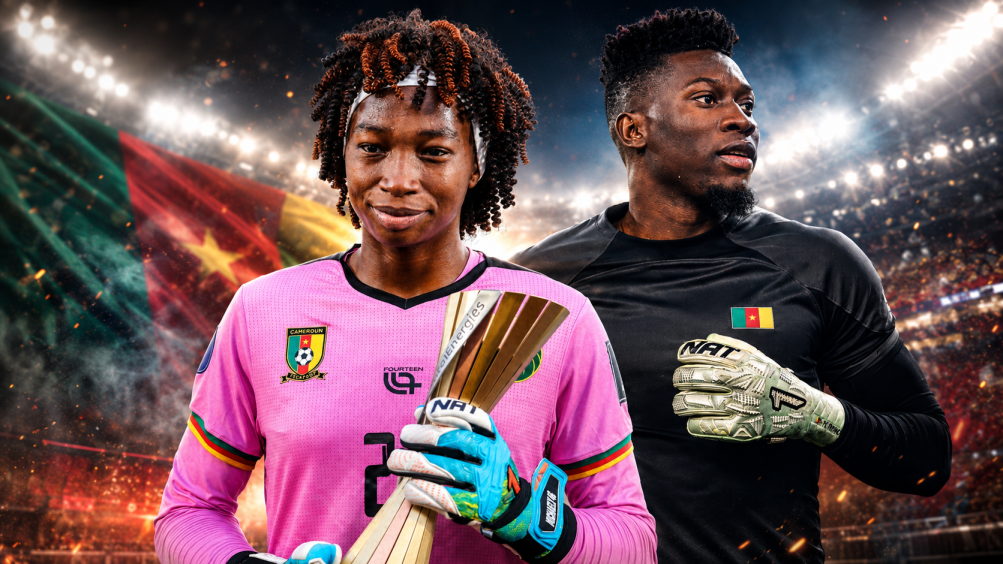
CAMEROONONLINE.ORG | As Cameroon prepares to face Malawi in the WAFCON final this Sunday, August 16, one name has become almost impossible to argue against: Michaely Bihina.
The 22-year-old goalkeeper has been one of the outstanding players of the tournament. She made nine saves as Cameroon eliminated Nigeria in the quarterfinals and then produced an extraordinary performance against hosts Morocco, saving an extra-time penalty before stopping three more in the shootout. She entered the final having gone more than 360 minutes without conceding.
Naturally, Cameroonian social media has done what Cameroonian social media does.
Memes, jokes and mockery have flooded timelines comparing Bihina with André Onana. Some have jokingly asked Onana to take lessons from her. Others have used every Bihina save as another opportunity to attack the Indomitable Lions goalkeeper.
The irony is that Bihina’s rise is not quite the anti-Onana story the memes suggest.
Before Benfica, before Racing Power and before the WAFCON heroics, Bihina was a goalkeeper at Éclair de Sa’a, the Cameroonian women’s club closely associated with the Onana family and supported by André Onana’s foundation. Her development there also brought her into contact with Onana himself. Reporting on her career describes him sharing advice with the club’s goalkeepers on areas including distribution, reading the game and decision-making.
Bihina would eventually leave Cameroon for Portugal, joining Racing Power in 2022. She helped the club win promotion, was later recognised as the Portuguese top flight’s best goalkeeper, and in February 2026 signed for Benfica, where she quickly added a league-and-cup double to her résumé.
Her personal European move should not be confused with another important initiative involving Onana: in 2023, the André Onana Foundation formalised a partnership between Éclair de Sa’a and CD Getafe Femenino in Spain, explicitly designed to give young Cameroonian women a route into European football. Raissa Mbappé and Rose Priso were among the early beneficiaries.
And that pathway is already producing remarkable stories.
Take Achta Toko Njoya, another product of Éclair de Sa’a and now Bihina’s teammate with Cameroon. She moved from Éclair to Getafe through the partnership involving the Onana Foundation, developed in Spain, joined Real Madrid in 2025 and has since been promoted to the club’s first team for the 2026–27 season. Other Cameroonian players including Cathy Biya, Eliane Manbolamo Bodolo, Marie Victoire Ngono, Camilla Daha and Saturne Nkada have also passed through the Getafe pathway.
That context matters.
None of it diminishes Bihina’s achievement. She is the one making the saves. She did the work. She earned her place at Benfica and has carried Cameroon through moments when elimination appeared imminent.
But football development is rarely the story of one person alone.
Behind the spectacular save seen by millions is often a club that gave a teenager a chance, a coach who developed her, a senior player who shared knowledge, and an institution that tried to create opportunities beyond Cameroon’s borders.
So by all means, enjoy the Onana-versus-Bihina memes.
Just remember the delicious irony: while the internet is using Michaely Bihina to mock André Onana, part of the football ecosystem associated with Onana helped provide the environment in which Bihina developed — and is helping other Lionesses find their own road from Sa’a to some of Europe’s biggest clubs.
Sometimes the better story is not who deserves to be mocked.
It is who helped build the pathway.