
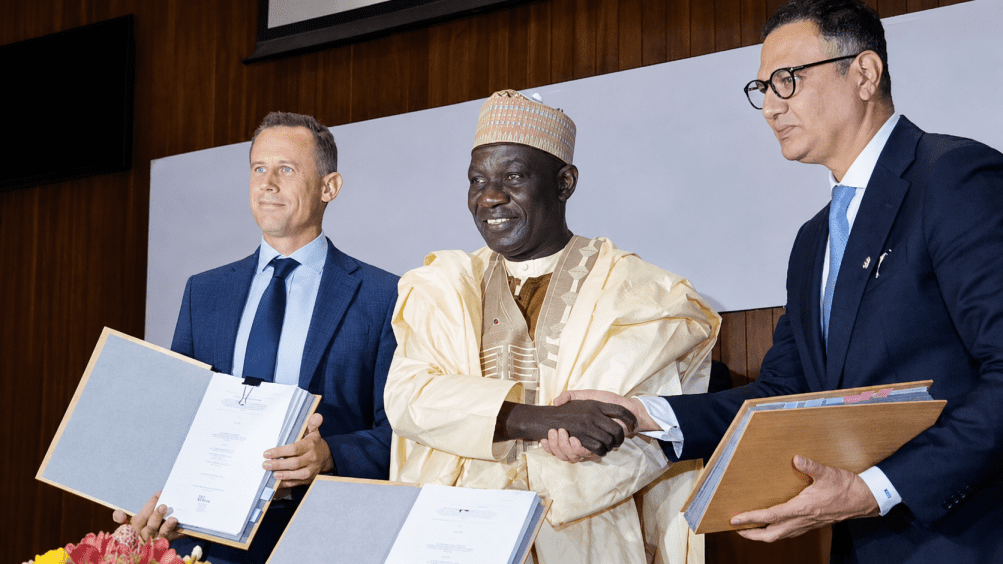
CameroonOnline.ORG | For nearly a decade and a half, the Ebolowa-Akom II-Kribi road project existed largely on paper—a multi-billion CFA promise stalled by bureaucratic hurdles and financing bottlenecks. But that 15-year waiting game has officially come to an end. According to a recent report by Business in Cameroon, the Cameroonian government has signed a pivotal CFA130.4 billion ($214 million equivalent) loan agreement with Standard Chartered Bank, effectively reviving the long-delayed highway infrastructure.
Backed by UK Export Finance (UKEF), this latest agreement brings the total funding mobilized from the London-based financial institution to CFA138.2 billion.
A 15-Year Journey from Promise to Reality
The 179-kilometer corridor has a long history. It was first announced to the public way back in 2011 by President Paul Biya during an agricultural fair in Ebolowa. Since then, the vital link remained an unpaved, often unpredictable track.
While Italian construction firm ICM Construction was awarded the direct contract by the Ministry of Public Works back in March 2022, actual physical progress ground to a halt. Lenders required rigorous technical, environmental, and social compliance standards to protect local ecosystems and indigenous communities before unlocking capital. With those final hurdles cleared, the financial structure is officially locked in.
“The road corridor is part of Cameroon’s wider infrastructure and logistics expansion strategy centred on Kribi, which has increasingly become a gateway for regional trade serving neighbouring countries.” — Ministry of Economy, Planning and Regional Development
Why This Road Changes the Game
The Ebolowa-Kribi highway is far more than just a strip of fresh asphalt; it is an economic artery for the country and its neighbors.
-
Unlocking the Port of Kribi: The deep-water Port of Kribi is rapidly morphing into Cameroon’s primary maritime logistics hub. This newly paved corridor will drastically reduce transport times and costs to and from the port.
-
Empowering Local Agriculture: Southern Cameroon is rich in agricultural production. Giving farmers a seamless, year-round route to transport their commodities ensures faster access to both regional export markets and local domestic consumers.
-
Boosting Sub-Regional Trade: The highway isn’t localized. It serves as a vital cog in a grander regional trade network, smoothly linking Cameroon’s coast to landlocked and neighboring sub-central African markets including Chad, the Central African Republic, Gabon, and Congo.
What Happens Next?
With the signatures finalized by Economy Minister Alamine Ousmane Mey on May 15, attention now pivots directly to the ground.
While the major funding is secured, a few administrative steps remain—including executing startup advances to the construction and supervision teams, clearing final rights-of-way, and managing compensation for local communities along the path.
After 15 years of false starts, the overarching question hanging over the corridor has finally shifted from “Will it ever be funded?” to “How fast can they build?”