
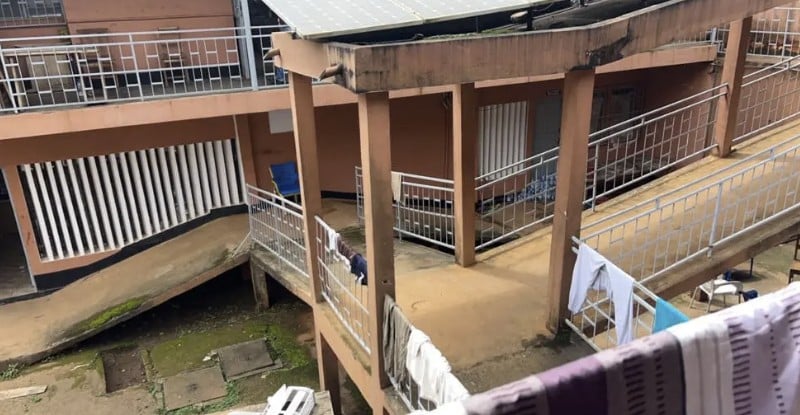
CAMEROONONLINE.ORG | Across Cameroon’s capital, Yaoundé, dozens of migrants from across the African continent—hailing from Ethiopia, Angola, Ghana, the Democratic Republic of the Congo, and Zimbabwe—are trapped inside a state-run facility, living in an agonizing legal limbo. None of them are Cameroonian. Most had never set foot in the country before being shackled and placed onto secretive charter flights originating in the United States.
A joint investigation by France 24, RFI, and the Forbidden Stories media consortium exposes the reality behind the White House’s mass third-country removal policy, which has seen over 25,000 asylum seekers expelled not to their homelands, but to third-party states.
Watch the France 24 Investigation

The Secret Diplomatic Notes: How Washington Outsourced Asylum to Yaoundé
The legal framework facilitating these removals to Cameroon rests on an exchange of classified diplomatic notes finalized between Washington and Yaoundé. Under this agreement, Cameroon consented to accept deportees of various nationalities whom US authorities sought to expel.
Between January and August 2026, multiple flights landed quietly in Cameroon carrying individuals who had fought for protection in US immigration courts. Crucially, many had actually won withholding of removal or protection under the UN Convention Against Torture (CAT)—orders barring the US government from sending them back to their native countries due to verified threats of death or torture. Exploiting a legal loophole, the Trump administration designated third countries like Cameroon to bypass those rulings while still expelling the migrants from US soil.
“Waiting for Us to Crack”: Life Inside the Yaoundé Shelter
Inside the government-run shelter in Yaoundé, deportees describe an environment characterized by isolation, confiscated identity documents, and severe psychological distress:
-
Barbara, an Ethiopian refugee who fled brutal wartime violence in Tigray, journeyed through Latin America to reach the US border. Despite securing legal protection against deportation to Ethiopia, she was flown to Cameroon without notice. Left without money or legal status, she describes the strategy as an attempt to wear them down mentally: “They are just waiting for us to crack and sign for voluntary return.”
-
Soraya, an asylum seeker from Ghana who fled persecution over her sexual orientation, found herself dumped into Cameroon—a country where consensual same-sex relations carry up to five years of imprisonment under local penal law.
-
No money, no papers: Stripped of their passports by US authorities before departure, many residents were initially detained behind closed gates under plainclothes security, facing constant threats of arbitrary detention or secondary refoulement.
The Legal Counterattack in Cameroonian Courts
The deal has sparked an unprecedented legal showdown on Cameroonian soil. Prominent Cameroonian human rights attorney Joseph Ava Fru has filed a lawsuit before the Yaoundé Administrative Court on behalf of 36 deported migrants, demanding the immediate suspension of the US–Cameroon transfer agreement.
The petition argues that the executive agreement was never constitutionally ratified and breaches Cameroon’s domestic and international obligations regarding the non-refoulement of refugees.
For the Cameroonian public, the revelations highlight how the country’s territory and sovereignty have been entangled in a transactional geopolitical bargain—transforming local facilities into holding centers for Washington’s mass deportation drive.